What are the official basketball court dimensions? And what measurements should be considered when designing and constructing a professional basketball court?
Basketball is a sport that depends on accurate design and proper court preparation according to specific standards to ensure high-quality gameplay and player safety. Therefore, understanding basketball court dimensions is an essential step before constructing any basketball court, whether for schools, sports clubs, or recreational facilities.
Designing a basketball court is not limited to determining the length and width only. It also includes selecting the appropriate flooring system, marking court lines, determining the basket height, and providing sufficient movement areas around the court.
The basketball court dimensions and measurements vary depending on the organizing body and competition level. However, the official dimensions approved by the International Basketball Federation (FIBA) are the most commonly used reference when designing professional courts.
What Are the Official Basketball Court Dimensions?
The official basketball court dimensions according to FIBA international standards are:
- Court length: 28 meters.
- Court width: 15 meters.
- Total playing area: approximately 420 square meters.
The court surface must be flat and free from any obstacles to ensure safe player movement during games. The playing area also requires additional space around the boundaries to provide safe zones and proper movement areas.
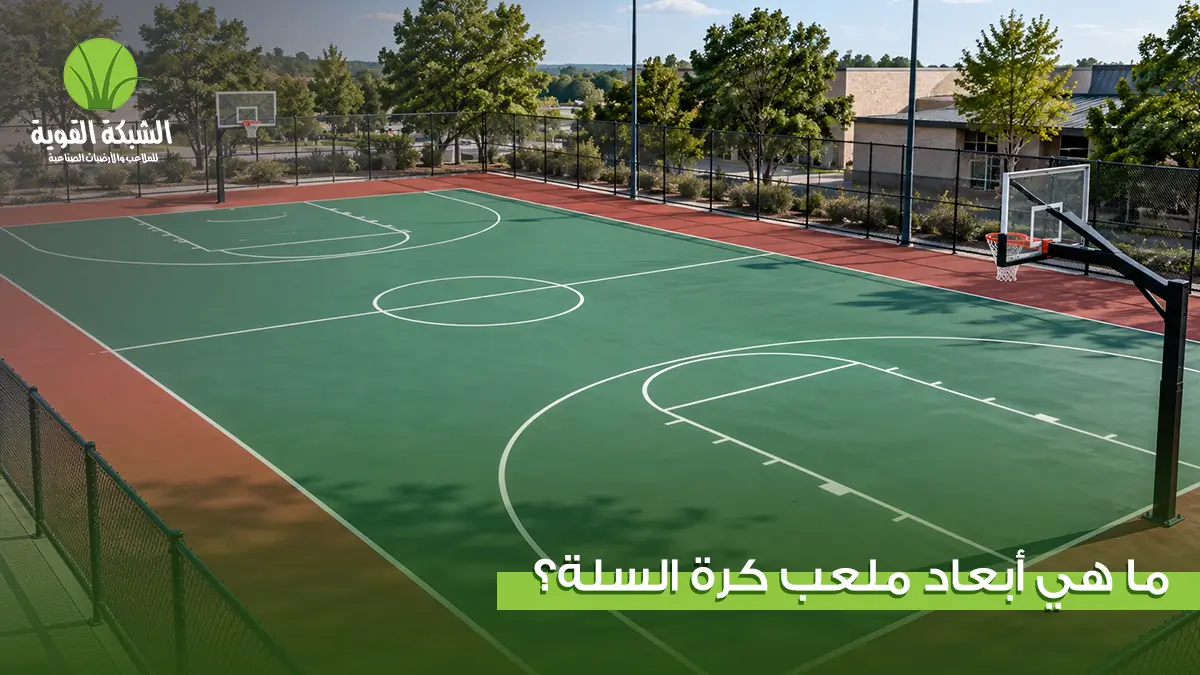
When constructing a professional basketball court, the design does not depend only on the total area. The internal court markings and zones must also be accurately positioned, including the free-throw area, center circle, and three-point line
What Are the Basketball Court Line Measurements?
Basketball courts include several lines and areas with specific measurements that help organize gameplay. The most important ones include:
Center Circle
The center circle is located in the middle of the court and is used at the beginning of the game. Its diameter is determined according to approved basketball standards.
Free Throw Area
Located in front of the basket, this area defines where players stand when taking free throws. It is designed according to specific measurements to ensure fair gameplay.
Three-Point Line
This line defines the distance from which successful shots are counted as three points. Its position varies depending on the competition regulations.
Therefore, constructing a basketball court requires accurate planning of court markings and layout, not just preparing an empty space and installing baskets.
What Is the Official Basketball Hoop Height?
The official basketball hoop height from the court surface is:
3.05 meters
This height is a fixed standard in official competitions, including international tournaments and most professional basketball courts.
Basketball hoop equipment includes:
- Backboard.
- Metal rim.
- Net.
- Secure support system.
Choosing high-quality equipment helps provide a better playing experience and increases the lifespan of the basketball court.
What Is the Official Basketball Size?
The basketball size varies depending on the players’ age group and competition type, as there are several internationally used sizes.
Size 7 Basketball
- This is the most commonly used size in men’s competitions. It has an approximate circumference of 75 cm and is used in official adult games.
Size 6 Basketball
- Mainly used in women’s competitions and some age groups. It is slightly smaller than the official men’s basketball size.
Size 5 Basketball
- Designed for children and young players, helping them control the ball more easily according to their age.
Therefore, choosing the correct basketball ball size depends on the players’ age and usage level, not only on the court itself.
Do Basketball Court Dimensions Differ Depending on Usage?
Yes, basketball court dimensions can vary depending on the type of use. Courts used for official competitions must fully comply with international standards, while smaller courts can be designed for schools, recreational facilities, or community spaces according to the available area.
Examples include:
- School basketball courts: The size may be adjusted according to students’ age groups and available space.
- Community basketball courts: The design can be customized based on the available area and expected usage.
- Professional basketball courts: These follow official international measurements and technical requirements.
Therefore, before constructing a basketball court, it is important to determine the purpose of the court to select the most suitable design and specifications.
What Is the Best Flooring for a Basketball Court?
The quality of a basketball court does not depend only on basketball court dimensions, as the flooring system plays an important role in player performance, safety, and overall playing experience.
The most common flooring options include:
Acrylic Flooring
- Widely used for outdoor basketball courts due to its durability, weather resistance, and easy maintenance.
Rubber Flooring
- Provides good shock absorption and is suitable for some indoor basketball facilities.
Professional Wooden Flooring
- Commonly used in professional indoor courts and official competitions due to its performance characteristics.
Choosing the right flooring depends on the court location, usage frequency, environmental conditions, and available budget.
You can explore sports court projects completed by Al Shabaka Sports to learn more about different design and construction solutions.
What Area Is Required to Build a Basketball Court?
The required area depends on the type of court. A standard basketball court requires a playing area of 28 × 15 meters, in addition to safety zones surrounding the court.
When building a basketball court in a school or residential community, the available space can be studied to create a suitable design without affecting gameplay quality.
A proper site assessment before construction helps determine the best space distribution and select the appropriate equipment and specifications.
Stages of Designing and Constructing a Basketball Court
The process of constructing a basketball court goes through several essential stages:
Site Assessment and Design
- The available space, intended use, and required specifications are determined before starting the construction process.
Ground and Flooring Preparation
- This stage includes leveling the site and preparing the suitable base for installing the sports flooring system.
Installing Flooring and Court Markings
- The selected flooring system is installed, followed by applying court lines according to approved basketball measurements.
Installing Sports Equipment
- This includes installing basketball hoops, backboards, safety systems, and lighting solutions when required.
Why Do You Need a Specialized Company for Basketball Court Construction?
Building a high-quality basketball court requires expertise in selecting suitable materials, applying accurate measurements, and installing flooring systems and equipment according to the required standards.
Al Shabaka Sports provides integrated solutions for designing and constructing sports facilities, starting from site assessment and planning to complete basketball court preparation according to each project’s requirements.
You can contact Al Shabaka Sports to get professional advice about designing and constructing the basketball court that matches your needs.
Frequently Asked Questions About Basketball Court Dimensions?
What Are the Length and Width of an Official Basketball Court?
The official basketball court length is 28 meters, while the width is 15 meters according to International Basketball Federation standards.
How Much Area Does a Basketball Court Require?
An official basketball court has a playing area of approximately 420 square meters, excluding the surrounding safety zones.
What Is the Suitable Basketball Size for Adults?
Adult players typically use a size 7 basketball in official competitions.
Do Basketball Court Measurements Differ in Schools?
Yes, basketball court measurements can vary depending on players’ age groups and available space. However, professional courts follow international standards.
What Is the Best Flooring for an Outdoor Basketball Court?
The best flooring depends on the intended use and environmental conditions. Acrylic flooring is one of the most common choices for outdoor basketball courts due to its durability and resistance to weather factors.