Why do some football fields develop problems shortly after construction? What mistakes should be avoided to achieve a high-quality playing field?
Building a football field requires careful engineering planning, expertise in material selection, and proper execution at every stage. A successful field depends not only on installing the turf or setting up the goalposts, but also on design quality, ground preparation, drainage systems, and selecting the right playing surface.
Mistakes in football field construction are among the main factors affecting a field's lifespan and performance. Errors during the design or construction stages can lead to problems such as water accumulation, surface damage, and reduced playing performance.
Understanding these mistakes before starting a project helps facility owners, clubs, and schools make better decisions and avoid future repair costs.
What Are the Most Common Football Field Construction Mistakes?
Football field construction mistakes often occur because the project has not been adequately assessed or because solutions that are unsuitable for the intended use have been selected.
The most common mistakes include the following:
1. Failing to Assess the Site Before Construction
Site assessment is one of the first essential steps before building a football field. It involves evaluating:
-
Soil conditions.
-
Ground levels.
-
Sun and wind direction.
-
Water drainage requirements.
-
Available space.
Ignoring this stage may lead to future problems, such as an uneven playing surface or insufficient ground stability.
2. Choosing an Unsuitable Playing Surface
One of the most significant football field construction mistakes is choosing a playing surface that does not match the intended use.
For example, a training field has different requirements from a professional stadium or a school football field. Therefore, the appropriate turf or surface system should be selected based on:
-
Number of operating hours.
-
Players' skill level.
-
Field location.
-
Climatic conditions.
Artificial turf is widely used in many sports projects because it can withstand frequent use and reduce maintenance requirements when installed correctly.
You can explore sports field projects completed by Al Shabaka Sports to learn more about real construction projects.
3. Neglecting Base Layer Preparation
The base layers beneath the playing surface are among the most important elements affecting construction quality.
Common mistakes when building football fields include:
-
Inadequate ground leveling.
-
Using unsuitable materials in the foundation layers.
-
Insufficient soil compaction.
-
Failing to prepare a suitable base for artificial turf.
These issues may cause surface irregularities or uneven areas that affect ball movement and player safety.
4. Poor Water Drainage Systems
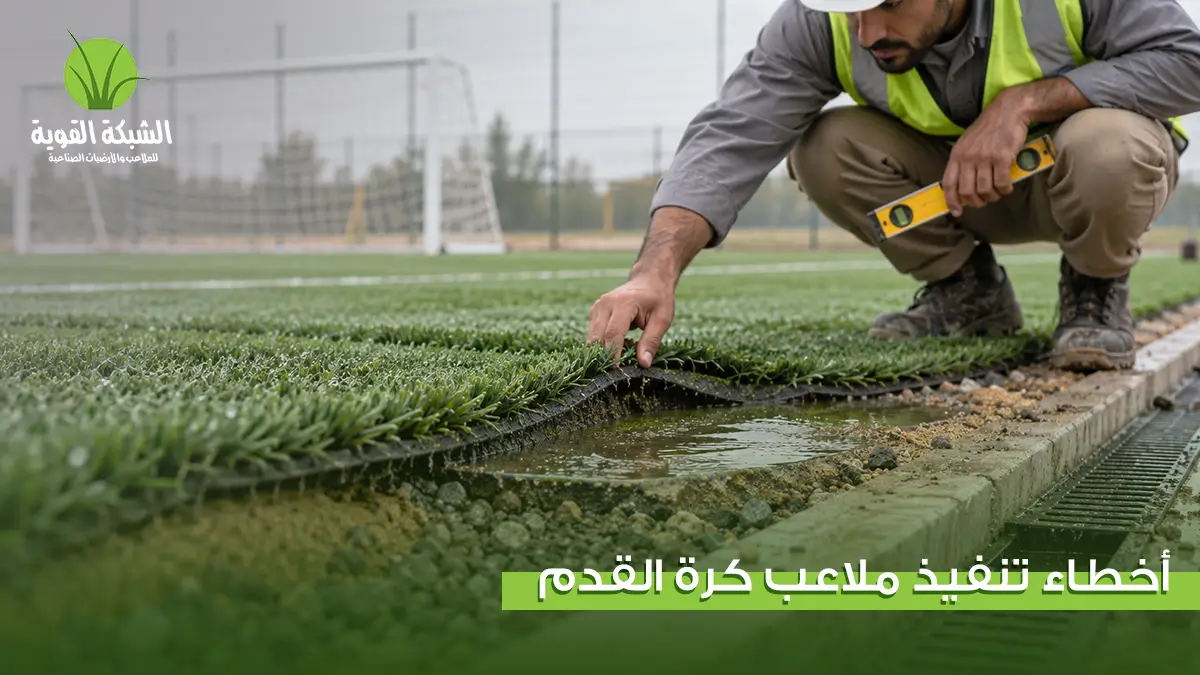
Water drainage is one of the most important aspects of football field design and construction, particularly for outdoor fields. Neglecting an effective drainage system is a major construction mistake that can cause significant problems.
Poor drainage may result in:
-
Water accumulation after rainfall.
-
Damage to the underlying surface layers.
-
Reduced playing quality.
-
Increased maintenance requirements.
Therefore, drainage systems and surface gradients must be considered when designing football fields. Appropriate drainage solutions should be installed before the sports surface is laid to ensure efficient field performance and maintain its quality for as long as possible.
5. Failing to Follow Standard Field Dimensions and Sports Regulations
Football field construction must comply with the appropriate dimensions for the intended use.
These standards include:
-
Overall field dimensions.
-
Penalty areas.
-
Boundary lines.
-
Goal positions.
The official Laws of the Game specify the requirements for the playing area and field markings in accordance with standards established by the International Football Association Board (IFAB).
Therefore, the appropriate football field dimensions must be considered during the design and construction stages to ensure that the field meets the requirements of its intended use and relevant sporting standards.
Failure to follow these requirements may make the field unsuitable for competitions or professional use.
6. Using Low-Quality Materials to Reduce Costs
Some project owners may attempt to reduce their budgets by choosing lower-quality materials. However, this decision can lead to higher costs in the future.
Examples include:
-
Selecting unsuitable artificial turf.
-
Using low-quality sports equipment.
-
Compromising the quality of the base layers.
-
Neglecting protective measures.
It is therefore advisable to adopt the latest sports field construction technologies and select materials suited to the field's intended use. This helps improve construction quality, extend the field's lifespan, and reduce future maintenance costs.
Price is an important factor, but it is essential to balance cost, construction quality, and the expected lifespan of the field.
Common Mistakes When Installing Artificial Turf on Football Fields
Installing artificial turf requires specialized expertise. Common installation mistakes include:
-
Installing turf over an inadequately prepared surface.
-
Poorly securing the seams between turf sections.
-
Uneven distribution of infill materials.
-
Ignoring the direction of the turf fibers.
These mistakes can affect the field's appearance and performance and may shorten the lifespan of the playing surface.
7. Neglecting Maintenance After Construction
Even when a football field is constructed to a high standard, regular maintenance is essential to preserve its performance.
Maintenance activities include:
-
Cleaning the playing surface.
-
Inspecting high-use areas.
-
Addressing early signs of damage.
-
Monitoring drainage systems.
Neglecting maintenance can cause the field's quality to deteriorate within a relatively short period.
How Can Football Field Construction Mistakes Be Avoided?
The likelihood of problems can be reduced by following several essential steps.
Choose a Specialized Contractor
An experienced contractor can help select suitable solutions and execute the project according to the required standards.
Conduct a Technical Assessment Before Construction
The assessment should cover:
-
Site conditions.
-
Playing surface type.
-
Project requirements.
-
Construction stages.
Use Materials of Appropriate Quality
Selecting suitable materials helps extend the field's lifespan and reduce maintenance costs.
Why Do You Need a Specialized Football Field Construction Company?
Building football fields requires expertise in engineering design, ground preparation, and the installation of various sports systems.
Al Shabaka Sports provides integrated solutions for sports field design, construction, and equipment installation, from the initial site assessment to project handover, ready for use.
Specialized expertise helps prevent football field construction mistakes and achieve the best possible results in terms of quality and performance.
You can visit Al Shabaka Sports, a sports field design and construction company, to explore the solutions available for your project.
Frequently Asked Questions About Football Field Construction Mistakes
Why Do Problems Occur in Football Fields After Construction?
Problems often result from poor ground preparation, inappropriate material selection, inadequate drainage, or incorrect execution of technical construction stages.
What Are the Most Common Mistakes When Installing Artificial Turf?
Common mistakes include installing turf over an unsuitable base, inadequate fastening, and choosing a turf type that does not match the field's intended use.
Can Football Field Construction Mistakes Be Repaired?
Yes. Some problems can be corrected depending on their severity and condition. However, identifying mistakes early helps reduce repair costs.
How Can I Tell Whether a Football Field Has Been Properly Constructed?
Check the quality of the materials, construction procedures, ground leveling, drainage systems, and the field's performance after completion.
Does Construction Quality Affect a Football Field's Lifespan?
Yes. Construction quality is one of the most important factors determining a field's expected lifespan and long-term playing performance.